PUE and Cooling Efficiency in Mining Facilities
PUE — power usage effectiveness — is total facility power divided by the power your machines actually consume, and in bitcoin mining it decides whether a hall is profitable at all. Take a 10 PH/s farm built on 20 J/TH hardware: the chips draw about 200 kW, which is 4,800 kWh a day and roughly $288 of electricity at $0.06/kWh, against about $380 of gross mining income at today's difficulty. Every extra kilowatt spent on fans, pumps and chillers comes straight out of that $92 of headroom.
Key takeaways
- PUE is a ratio, so a gap of 0.2 on a 200 kW IT load is 40 kW of extra draw — about 960 kWh a day, or roughly $58 at $0.06/kWh.
- At a $0.06/kWh tariff and current difficulty, 20 J/TH hardware breaks even at a PUE of roughly 1.32; anything above that consumes the entire gross margin.
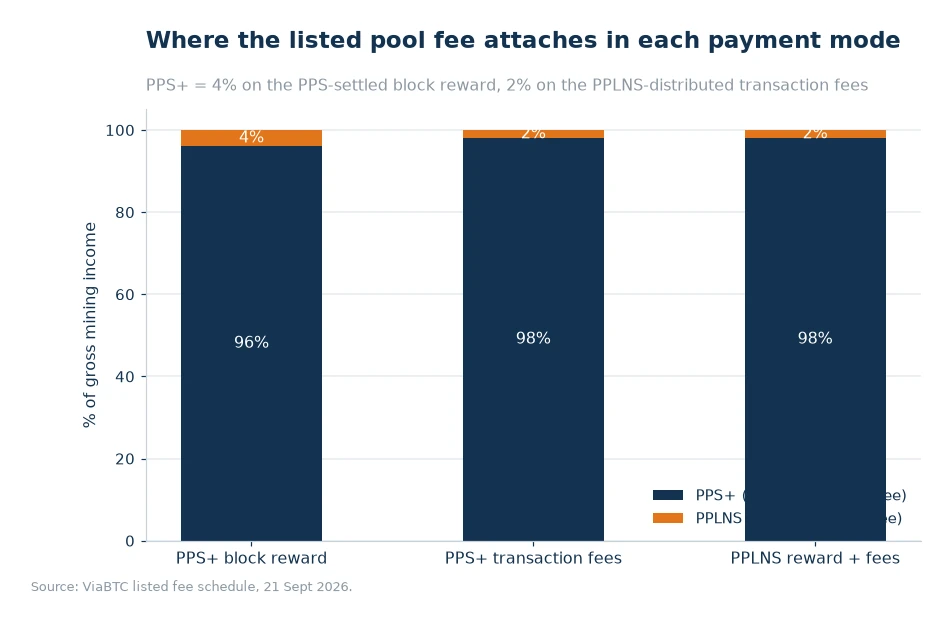
- Facility overhead scales with every machine you add, so it is a larger lever than the listed pool fee on the settlement side — the 4% and 2% components attach to different parts of a payout.[1]
- Measure PUE where the power enters and where it leaves the rack, not from a vendor's summary sheet: the only number that matters is your building, at your tariff, in your climate.
The short answer
A mining facility that runs at a PUE of 1.1 spends about 10% more electricity than its machines require. A facility at 1.5 spends 50% more. The hashrate produced is identical in both cases, so the entire difference lands on the operating statement.
This is why hosted capacity is usually priced per kWh rather than per machine. When a host quotes a tariff, the PUE is already baked into that number — you are paying for the kW that reaches the chips plus every kW the building burns to keep them alive. Comparing two hosts on tariff alone therefore also compares two cooling designs, whether or not either side says so.
The second-order effect matters just as much: overhead does not shrink when revenue falls. A difficulty adjustment or a price dip cuts income immediately and leaves the cooling load roughly unchanged, which is precisely when a high-PUE site turns a thin margin into a loss.
How the mechanism works
Almost every kilowatt that enters a miner leaves it as heat, and that heat has to be moved from the die to the air, from the air to a coolant, and from the coolant to the outside. Each of those steps has a cost: fans inside the chassis, air handlers or pumps in the hall, and chillers or dry coolers on the roof.
Design choices set how much those steps cost.
- Airflow discipline. Separating cold intake from hot exhaust and removing recirculation lets inlet temperatures stay inside the manufacturer's range with less fan work.
- Coolant choice. Dry cooling with ambient air removes the compressor load that a chiller adds, but it only works while the ambient temperature allows it.
- Setpoint and ramp control. Fans and pumps that run at a fixed high speed waste power at night and in cold seasons; variable control tracks the heat actually being produced.
- Containment and rack density. Predictable airflow across every machine keeps hot spots from forcing the whole hall to run colder than it needs to.
On the settlement side the picture is simpler. A payout has a block-reward component and a transaction-fee component, and the listed fees attach to them differently: the block-reward part is settled per share under the PPS model with a listed 4% fee, while transaction fees follow PPLNS logic with a listed 2% fee. That distinction is worth understanding, but it operates on percentages of a payout — cooling overhead operates on every kilowatt-hour, all day, including the ones where the pool finds nothing.
The arithmetic of a 10 PH/s hall
Hold the IT load constant at 200 kW — 10 PH/s of hardware at 20 J/TH — and vary only the facility overhead. Gross income stays about $380 a day at the difficulty, hashrate and BTC price read on 21 September 2026, and the tariff stays at $0.06/kWh.
| Facility PUE | Total draw | Electricity per day | Power cost per day | Result against $380 gross |
|---|---|---|---|---|
| 1.00 (no overhead) | 200 kW | 4,800 kWh | $288.00 | +$92 margin |
| 1.10 | 220 kW | 5,280 kWh | $316.80 | +$63 margin |
| 1.20 | 240 kW | 5,760 kWh | $345.60 | +$34 margin |
| ≈1.32 (break-even) | 264 kW | 6,336 kWh | $380.16 | break-even against ≈$380 gross |
| 1.50 | 300 kW | 7,200 kWh | $432.00 | -$52 loss before any other cost |
The break-even point is the number to remember. Everything else in the table is a way of expressing the same idea: at this hardware efficiency, this tariff and this difficulty, roughly a third of the gross income can be consumed by the building before the machines stop paying for themselves. Hardware efficiency moves that line, price and difficulty move the revenue side, and the tariff moves the cost side — but the ratio between them is what you actually manage.
Where miners get it wrong
Comparing tariffs without comparing PUE
A host charging $0.055/kWh at a PUE of 1.4 is not cheaper than a host charging $0.07/kWh at 1.1 for the same hardware. The first site burns 1.27 times as much power per unit of hashrate, and the buyer pays for all of it in the tariff line. The only fair comparison is cost per unit of hashrate produced, per day.
Treating nameplate efficiency as the final number
Joules per terahash describes the machine, not the site. Once the hall is included, a fleet's real efficiency is the nameplate figure multiplied by the facility PUE — which is why the same machine can be profitable in one building and unprofitable in another. The miner profitability ranking shows which models clear their running cost at the current coin price and difficulty; what it cannot see is your building.
Ignoring the summer and the cold
Cooling load is seasonal even when hashrate is flat. A design that only balances on a mild day will either throttle machines in July or overspend on chilling for the rest of the year. The engineering question is whether the site can hold inlet conditions at the hottest hour of the year without adding compressor capacity, because that capacity bills you for the other 11 months.
Forgetting that fans are a running cost, not a capital one
Fan power shows up every hour of every day. A design that trades a small increase in fan energy for a large reduction in chiller energy usually wins, but the only way to know is to measure at the metering point rather than reasoning from the rack inward.
A checklist you can run today
- Read the meter, not the datasheet. Note total facility draw and total IT draw at the same moment, at the hottest part of the day, and divide them.
- Convert everything to cost per hashrate. Total power cost per day divided by the hashrate that power produced is the only figure that compares two sites honestly.
- Model the break-even PUE. Gross daily income divided by the IT load's power cost gives the ceiling your facility can reach before it stops contributing.
- Run the estimate before the upgrade. A profit calculator that accepts coin price, difficulty, fee rate and effective hashrate turns a hardware or hosting decision into arithmetic instead of instinct, and it accounts for merged-mining output as well as the primary chain.[2]
- Tie running cost to uptime data. A site with good airflow and a bad firmware setting loses more money than a site with a worse PUE and stable machines; monitor both.
- Price the hosting option. If building the electrical and cooling infrastructure in-house is not realistic, the ViaBTC Mining Farms entry point lists hosting capacity as an alternative, and the same break-even arithmetic applies — just in someone else's tariff.
Wherever the machines sit, keep the monitoring close. Pool-side data and facility-side data answer different questions: the pool dashboard tells you whether every worker is submitting shares, while your own meter tells you what those shares cost to produce. Miners who look at only one of the two usually discover the problem from an invoice.
Frequently asked questions
Does the payout method change my average income?
It changes the variance and the fee, not the underlying expected value: your share of network hashrate still sets the ceiling.
How often should a miner check pool statistics?
Weekly is enough for cash flow, daily if you are reconciling worker uptime or chasing a hashrate fault.
What PUE should I aim for?
There is no universal target, because the ceiling depends on the tariff, hardware efficiency, coin price and difficulty. Work backwards from break-even: at 20 J/TH hardware, a $0.06/kWh tariff and current difficulty, the ceiling sits near 1.32, and every improvement below that widens the margin.
Is cooling the biggest operating cost?
Not usually — the machines themselves are. But it is the largest cost a facility can influence without replacing hardware, and it applies to every machine at once, which is why it deserves the same attention as the mining fee.
Fix the building before you buy the next rack
Measure your PUE at the hottest part of the day, convert it into a cost per unit of hashrate, and compare that figure with the break-even line for your hardware and tariff. If the gap is thin, airflow containment, setpoint discipline and variable-speed control usually cost far less than a new mining hall, and they take effect immediately. Only once the building is efficient does the fee side deserve a second look — and there, check both components of the listed schedule rather than the headline number.
Data and sources: listed payout components and fee rates are published on the ViaBTC pricing page[1]; network difficulty (132.76 T), network hashrate (about 1,003 EH/s), the 3.125 BTC block subsidy and BTC/USD 84,692 were read on 21 September 2026, the same date the profitability ranking and hosting pages linked above were read; day-to-day estimates come from the estimation tool[2]. PUE scenarios and margins are own calculations from those inputs and change with tariff, hardware efficiency and difficulty.